Welcome back to my “how to stencil” series during which I’m also highlighting the stencils I designed for the most recent TCW (The Crafter’s Workshop) release. Today we are playing with TCW960: Cosmic Music.
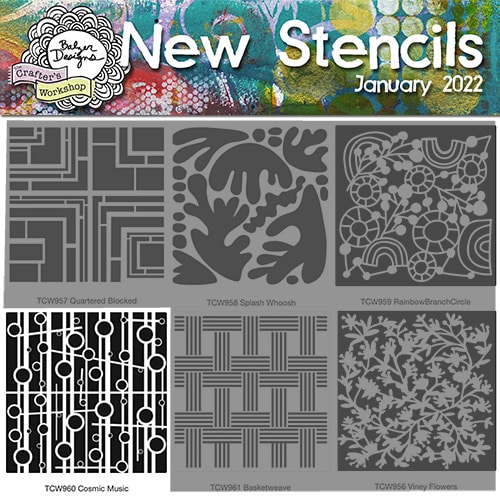
This is the first stencil I designed for the release. I love how this stencil design is both rigid and free at the same time. It makes for very dynamic images. Do let me know what you like about this design! I’m always interested to know.
Stencil Brush Basics
In this short video I’m sharing how I like to use a stencil brush and acrylic paint with stencils, along with how to make a simple card with your stenciled paper.
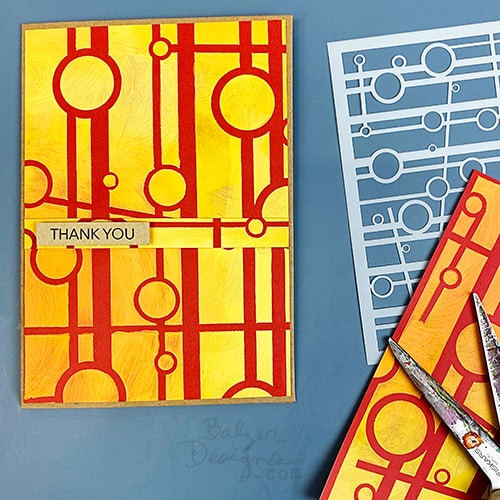
Here’s a better look at the card that I made in the video:
Take Aways from the Video:
Here are some things I hope you take away from the video. It’s not all about stenciling. Many of them are basic art principles.
- Your starting surface is part of the design. You don’t always have to begin with white paper. A colored ground can do a surprising amount of the visual work for you.
- Think about opacity when choosing colors. If you’re working on a dark or saturated surface, adding white to your paint can help lighter colors actually show up instead of disappearing into the background.
- Layer related colors to create depth. Moving through several yellows rather than using a single flat yellow creates a glow and makes a relatively simple technique look much more sophisticated.
- Color mixing doesn’t have to be obvious. Hot pink + yellow can give you a beautiful orange. Knowing how colors interact gives you more options than simply reaching for another tube of paint. If you’d like to learn more about color, consider my class: Practical Color For Painters.
- A limited palette can still produce a rich result. You don’t need lots of colors. Small shifts within a color family can create plenty of visual complexity.
- Good technique can make simple materials look impressive. Clean stenciling, thoughtful color choices, and a strong design can make a piece feel much more labor-intensive than it actually was.
- You don’t have to keep adding. Sometimes the patterned paper is already interesting enough. Knowing when to stop is as important as knowing what to add.
- Save your offcuts. Even a tiny strip of patterned paper can become an important design element rather than waste.
- Pattern-on-pattern can create a useful interruption. Changing the direction, scale, or placement of a pattern gives the eye a reason to stop and look.
- Small design decisions can establish hierarchy. That narrow patterned strip helps direct attention toward the sentiment. In a larger artwork, the same idea can be used to draw attention toward a focal point.
- Dimension is another design tool. Popping one element forward physically changes the visual hierarchy, even when everything else is relatively simple.
- Learn principles, not just projects. The most transferable lesson here is understanding why something works—opacity, contrast, color relationships, pattern, hierarchy—so you can make your own choices later rather than simply reproducing a specific card.
That last point feels like the most important takeaway: technique is useful, but understanding the design principle behind the technique is what gives you independence as an artist.
Final Thoughts
I have really enjoyed sharing these simple stenciling and card making ideas with you. Do let me know what kind of stencil ideas you’re looking for next time around!
Stencil links if you wish to buy any of them:
- TCW956: Viney Flowers 12×12: https://shrsl.com/3clb8 6×6: http://shrsl.com/3clbe
- TCW957: Quartered Blocked 12×12: http://shrsl.com/3clbg 6×6: http://shrsl.com/3clbh
- TCW958: Splash Whoosh 12×12: http://shrsl.com/3clbj 6×6: http://shrsl.com/3clbm
- TCW959: Rainbow Branch Circle 12×12: http://shrsl.com/3clbq 6×6: http://shrsl.com/3clbu
- TCW960: Cosmic Music 12×12: http://shrsl.com/3clbw 6×6: http://shrsl.com/3clc2
- TCW961: Basketweave 12×12: http://shrsl.com/3clc5 6×6: http://shrsl.com/3clc9
Other posts in this how-to stencil blog series:
- Six New Stencil Designs from Balzer Designs: Unboxing Video
- How to Stencil: Stenciling with Ink Pads on the Gelatin Plate!
- How to Stencil: Some Tips on Using a Stencil Brush (this post)
- How to Stencil: Making Ghost Prints with Stencils on a Gel Plate
- How to Stencil: Stamping Through a Stencil
- How to Use Spray Ink with Stencils: Get Two Prints from One Spray
- How to Stencil: Stamping with a Stencil

This is my favorite of this set of stencils, and I LOOOOVE what you did with layering the shades of yellow on the red!!!
Thanks, Sue!
No one NEEDs any art supplies. I only recommend things that are nice to have. 🙂 Have fun with your stencils!