The first cycle we ever did at My Art Practice was about being a beginner. That was not accidental. I have always thought there is something important about putting yourself back into that position where you do not know what you are doing yet. Most of us spend a lot of time trying to get out of beginnerhood. We want to become skilled, knowledgeable, confident, and fluent. We want to understand our materials and trust our instincts. All of that is good, of course. But I also think there is a danger in becoming too attached to competence. Let me explain.
I’m Being a Beginner with Paper Making
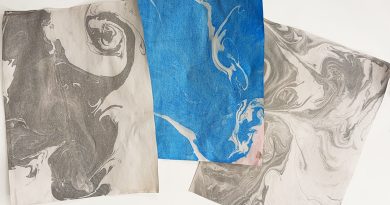
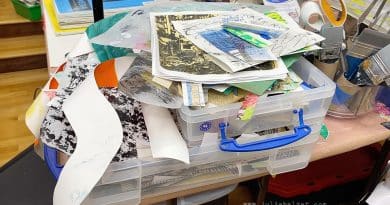
I have fallen down a paper making rabbit hole. I am very much at the beginning. I do not know all the terminology. I do not yet understand the personalities of the different fibers. I cannot necessarily predict how a sheet of paper will behave as it dries or how much it will shrink or whether what I am doing will produce the result I imagine. There is a lot I do not know, and it has reminded me how useful that feeling can be. You can see a bit about my journey in this video:
Being a Beginner Changes How You Pay Attention
When you have been making art for a long time, you accumulate an enormous amount of knowledge that you may not even realize you have. You reach for a particular brush because you know what kind of mark it will make. You understand how wet a piece of paper can get before it begins to buckle. You can often look at something that is not working and make a pretty good guess about how to fix it. Experience gives you a vocabulary of possible solutions.
But when you are a beginner, you do not have that vocabulary yet. Everything requires a little more attention. You notice things because you cannot take them for granted.
That has been one of my favorite parts of learning to make paper. I am suddenly intensely interested in things I barely thought about before. Fiber length. Shrinkage. Thickness. Absorbency. The difference between a sheet that feels soft and one that feels crisp. What happens when something is embedded in the pulp instead of glued on later. What happens when wet paper dries over a form and pulls itself tight. These are not necessarily sophisticated questions, but they are very alive questions because I genuinely do not know the answers yet.
I think that state of genuine curiosity is valuable for artists.
Interrupting Complacency
It is easy, once you know how to do something, to become focused on results. You know what successful work looks like for you, and you know what failure looks like too. That can make you efficient, but it can also quietly narrow the field of possibility. You begin to avoid the things you do not understand. You repeat processes that have worked before. You make decisions based on experience, which is often wise, but sometimes experience can keep you from wandering far enough to discover something unexpected.
Being a beginner interrupts that.
You are going to make things that are awkward because you do not yet know how to make them otherwise. You are going to misunderstand instructions. You are going to use too much of something or too little. You are going to make a sample that comes out badly and have no idea why. And that is so exciting! Learning and failure are opportunities to use your imagination and your creativity and ingenuity just a little bit more.
The Beginner Mindset is About Learning from Failure
One of the biggest differences I see between people who are comfortable making art and people who are struggling with it is not necessarily the number of mistakes they make. Experienced artists make mistakes all the time. The difference is often in what happens next. Instead of taking the mistake as a verdict on their ability, they treat it as information. Something did not work. Why? What changed? What could happen next?
That sounds simple, but I think it is actually a profound mental shift. The finished artwork stops being a test you can pass or fail and becomes a conversation you are having with materials, ideas, and your own decisions. This is part of why I chose “being a beginner” as the first cycle theme at My Art Practice. I am not interested in beginnerhood as a temporary stage that we should race through as quickly as possible. I am interested in the qualities that come with it: attention, curiosity, flexibility, willingness to ask obvious questions, and a certain tolerance for not knowing. Those are qualities I do not want to lose simply because I have become more experienced.
In fact, I think the longer you make art, the more deliberately you may need to seek them out.
Learn For the Sake of Learning
I have no idea whether paper making will become a significant part of my artwork. Maybe it will? Maybe not? Either way, it doesn’t make the learning less valuable.
We live in a culture that likes to make learning justify itself. We want to know what we are going to do with the skill before we have even acquired it. Will it become part of the work? Can it be monetized? Is it efficient? Is it useful?
But so much of what has mattered to me creatively has entered my art practice sideways. Something I learned in one context becomes useful years later in another. A material introduces a way of thinking. An idea from a book or a podcast sparks something in my brain. Sometimes all that happens is that I become interested again.
That is enough.
I think an art practice needs depth, repetition, and commitment. You have to stay with things long enough to get past the easy answers. But I also think an art practice needs occasional periods of genuine beginnerhood, where you allow yourself to enter a room without already knowing what is going to happen there.
Thanks for stopping by!
P.S. Check out my related post on how to kick yourself out of a creative rut HERE.