I want to talk about how I improvise when making art, but first I need to chat a bit about improvisation as an idea. (PS: Did you know that I worked in the theatre for years and taught improvisation to businesspeople at training courses?)
The Key to Good Improvisation
Have you ever heard of the “yes and” theory of improvisation? It’s an improv comedy rule that when you’re improvising with a partner and they say something, you keep the ball rolling forward (yes and) rather than shutting it down. For instance, if I say, “Wow! That whale is huge!” You might say, “Yes, and it’s swimming this way!” This keeps the scene rolling forward. If instead you reply, “I don’t see a whale. I’m just in my car on the way to work,” it completely derails the scene.
The problem is that people who do improv comedy want to be funny. They want to be good. And so sometimes they get attached to an idea that they think will be funny or good and stop listening and paying attention to where the scene is going. Instead, they want to use their pre-thought up idea and the scene becomes not funny and not good.
Art making often follows the same trajectory. You have a pre-thought up idea and you just have to get to it no matter what. As a result, you don’t pay attention to what’s actually happening in the work and it usually ends up falling flat. Boo.
However, it is my sincere belief that if you use the “yes and” rule in your art making, you will go in interesting direction you never could have planned for!
Responding Rather Than Inventing
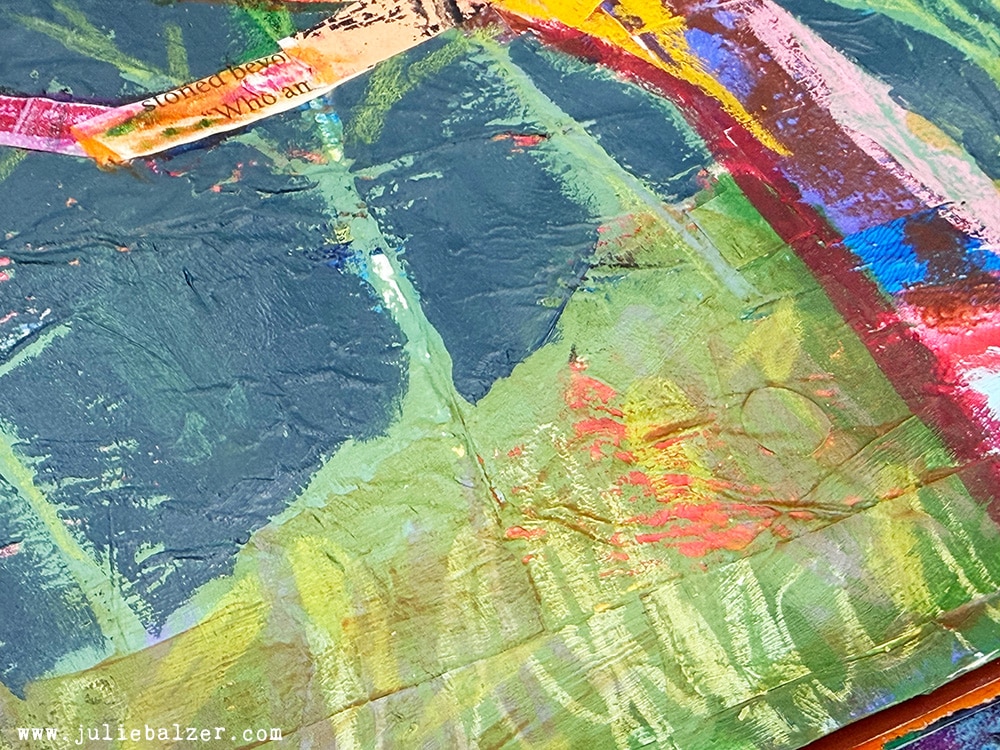
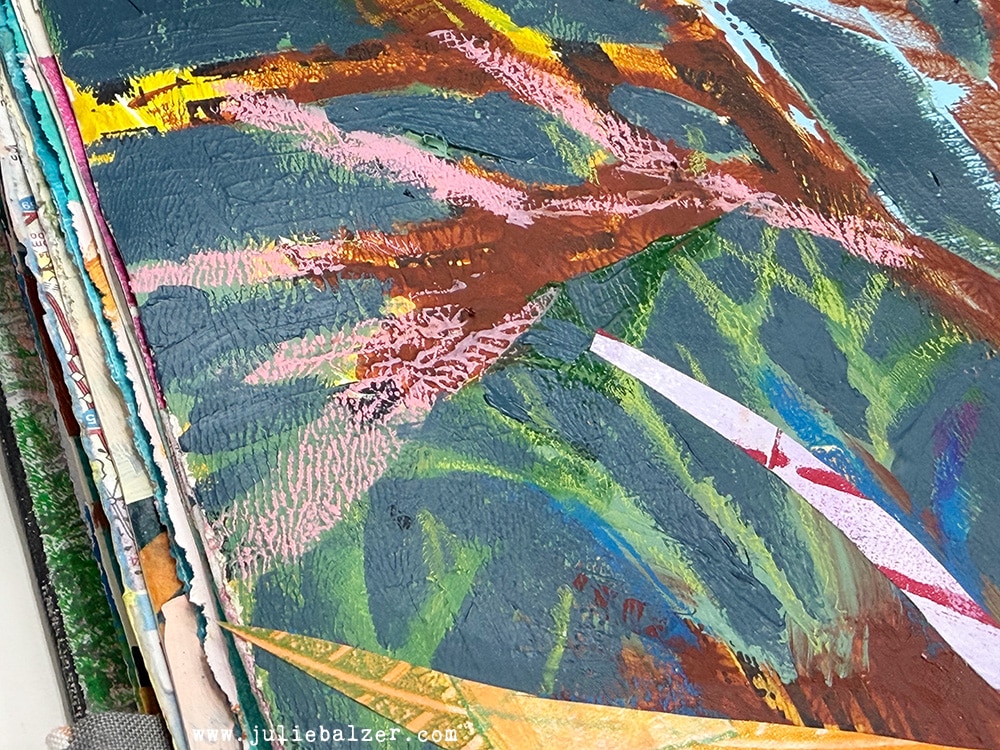
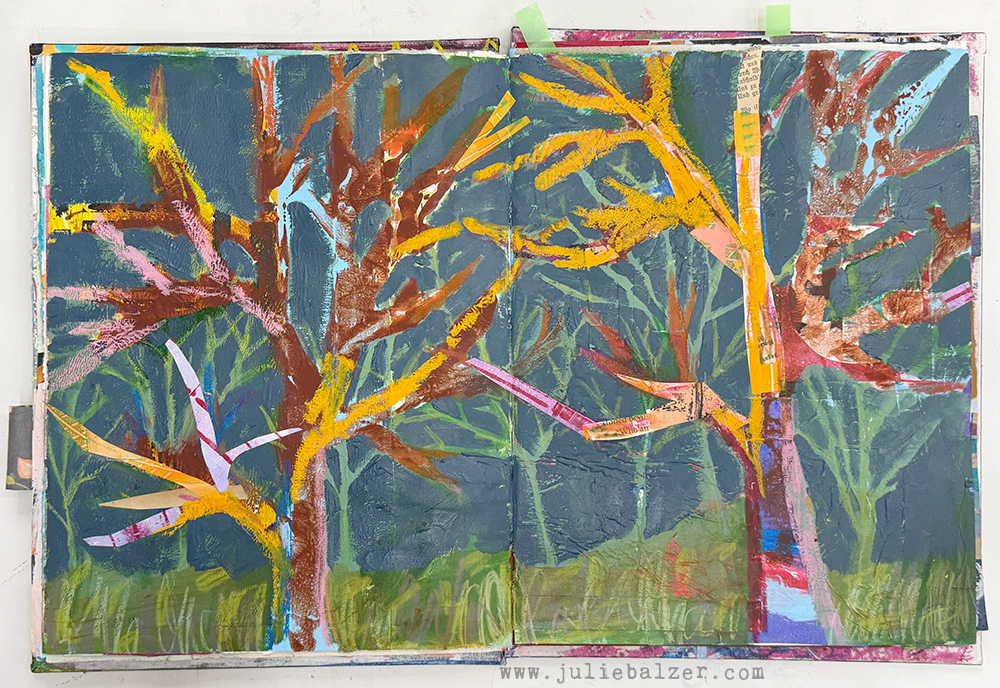
I prefer to work in a junque journal or a journal that I’ve taken the time to rough up. I hate a blank page waiting patiently for me to have a brilliant idea. For me, a blank page can feel like it is asking you to invent an entire world, whereas a page that already has something on it gives you a problem to solve. There is something to respond to and I love that. I need that!
In this video you’ll see that I start on a page that already has a lot of visual noise and then I make one decision, take a moment, and respond.
In my opinion, this is how to improvise in art. It’s not random. It’s thoughtful. It’s based on years of taking calculated risks. It’s saying, “yes and” to whatever happens in the process.
Ideas Worth Noting
Here are a few practical tips and ideas that I hope you take away from the video:
- You do not need to know what the finished artwork will look like before you begin. Make one decision, look at what changed, and then decide what to do next.
- An already-used surface can be easier to work on than a blank one. Existing color, collage, and marks give you something to respond to.
- Experience does not necessarily mean seeing the whole artwork in advance. It often means feeling more comfortable with uncertainty.
- Each new layer creates a new set of questions. Ask whether the work needs more contrast, depth, repetition, space, or movement.
- Repeating a shape at different sizes can create depth and help unify a composition.
- Grounding shapes can change how they read. A simple ground line or area can make floating elements feel like they belong in an environment.
- Materials should be chosen for what they do. Acrylic paint can cover and simplify, while crayon can add an immediate, physical line and move differently across the surface.
- Changing your mind is not separate from the art process. It is part of the process.
- A color does not have to be “bad” to need changing. It may simply be creating the wrong value, contrast, or emphasis.
- When something feels wrong, try to identify the actual problem instead of immediately calling it a mistake.
- Useful questions include: What is competing? What has disappeared? Where is my eye getting stuck? What needs to be repeated?
- New collage often looks disconnected at first. Repeating existing colors, marks, or materials over it can help integrate it into the rest of the work.
- Repetition is one of the simplest ways to create unity. You can repeat color, shape, line, texture, scale, or material.
- Art journals are valuable places to practice responding when things do not go as planned.
- Artistic control is not making everything happen exactly as imagined. It is being able to respond, adjust, and keep going.
Improvisation Needs to Be Practiced
As we already discussed, doing random things and hoping for the best is not improvisation. Viola Spolin put it best when she said, “Improvisation is the moment when planning and opportunity meet.”
Because the artwork is always going to do something you did not expect. The paint is going to dry darker or lighter than you thought it would. The print is going to land in a slightly strange place. The shape you thought would be subtle is suddenly going to become the loudest thing in the room. You are going to cover the part you liked best. You are going to add one tiny thing and somehow ruin the entire composition. Etc.
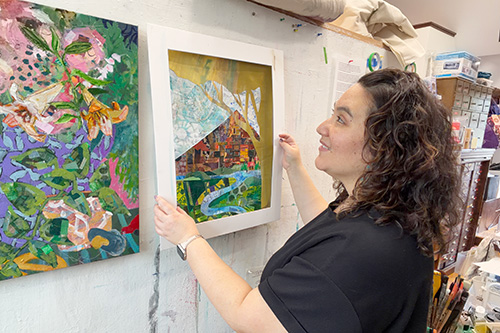
What has changed over time with education and experience is that I am less frightened by those moments because I have been there before. Many times. I know that an awkward stage is not necessarily the end. I know that one bad decision does not mean the entire piece is ruined. I know that there is more than one way forward. And I have confidence that, given time, I can figure it out.
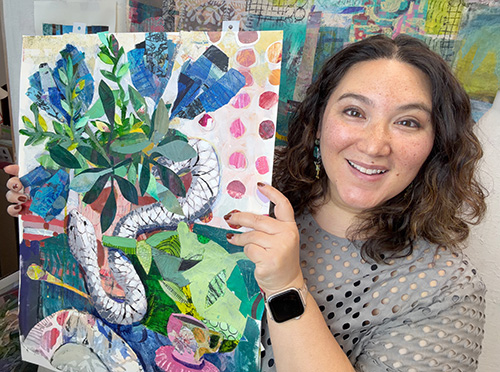
That confidence is because I have practiced and practiced and practiced. I have read books, and gone to art history lectures, and visited museums and galleries, and done my best to grab every tool available to me in order to learn and practice. This is actually a big part of why I started My Art Practice. I kept meeting artists who knew how to follow a project but felt completely lost when their own artwork took an unexpected turn. They did not necessarily need one more set of instructions. They needed more ways to think, more things to try, and more confidence in their own decisions.
That is what I wanted My Art Practice to help people build. We learn techniques, of course. But we also study color, composition, materials, art history, habits, and decision-making because all of those things give you more options when you are standing in front of your own work thinking, “Well, now what?”
That ability to improvise is what I am really interested in. The more you know, the more choices you have: You are not improvising because you have no idea what you are doing. You are improvising because you have built up enough experience to respond. (I’ve written before about why improvisation in art is intentional rather than random.)
Art Journals are Awesome for Practicing Improvisation
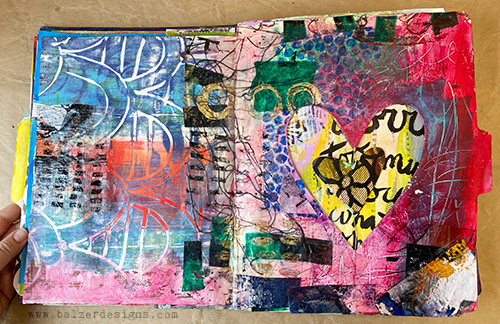
I think art journals are particularly good places to practice improvisation. For me, because it’s a book, the stakes feel lower. I can take lots of risks and then turn the page. The important things to keep in mind are:
- A page can be visually successful and still teach me very little.
- A page can be awkward, overworked, or not quite resolved and teach me a tremendous amount.
- I learn nothing if I don’t take the time to think about both the process and product.
- Taking some notes is always a good idea, even if it feels like a pain at the time.
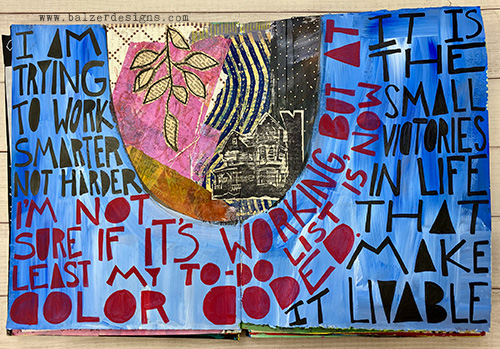
An Actionable Idea for You
The next time you get stuck in your artwork, try not to immediately ask, “How do I fix this?” Instead, ask: What changed?
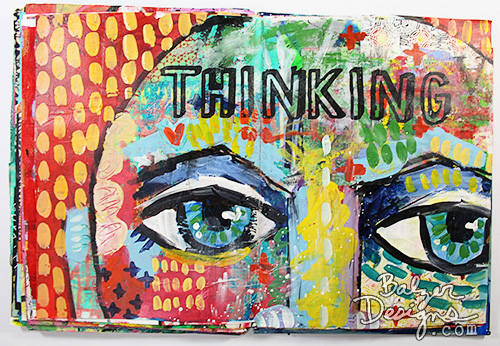
Did the focal point disappear? Did one color become too dominant? Is the composition too heavy on one side? Does the new collage element look as though it has been dropped on top rather than integrated into the page?
“I hate it” is a real feeling, but it is not especially useful information. The more specific you can be about what is bothering you, the easier it becomes to imagine more than one response. And that, for me, is the real skill. Mistakes (otherwise known as creative opportunities) are inevitable. The skill is being willing to look at what is actually there, change your mind, and continue.
Thanks for stopping by!