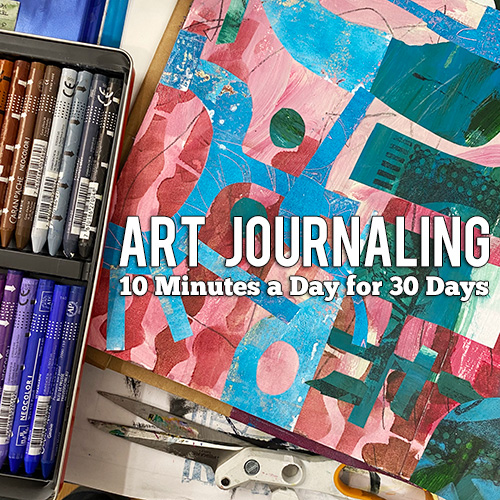
Viola Spolin once said, “Improvisation is the moment when planning and opportunity meet.” Improvisation is not random. It’s not pulled out of thin air. You practice. You learn. You use your knowledge. As I say in the video, I’m working off of a combination of knowledge — such as design principles, my tastes, how my art materials work, etc. In today’s Studio Visit Vlog, I’m sharing a clip from one the videos from my new online art journaling class!
Practicing Improvisation in Art
When I practice improvising in my art journal, I’m actually preparing myself for later when I’m working on a more finished work of art. I’m able to improv more easily at that time because I’ve practiced it here in my art journal. It’s all about intentional practice. In some ways, it’s like you’re rehearsing for your big moment. In many ways, your art journal is all about hypothesis — you have an assumption that you make at the beginning of the experiment about how it’s going to turn out, and then either it does or it doesn’t and you learn whether what you thought was true or not.
Watch the video for more:
Ideas of Note
Here are some ideas and tips that I hope you take away from the video:
- Improvisation is not the same as randomness. Your choices are informed by your knowledge of design, your technical skills, your personal taste, and your instincts.
- Your past experience gives you more freedom. The techniques and ideas you have practiced before become resources you can draw on in the moment.
- An art journal is a place to rehearse. The small decisions you make there prepare you to respond more confidently when working on larger or more important pieces.
- Practice the skills you want to use later. Cutting shapes, combining materials, resolving edges, and finishing compositions all become easier through repetition.
- Improvisation itself is a skill. The more often you practice responding to what is happening on the page, the more naturally you will be able to improvise in other artwork.
- Work one decision at a time. Ask what would look good, feel interesting, create continuity, or help bring the composition together.
- Think intentionally about what you are practicing. An art journal can be more than a place to play; it can help you strengthen specific artistic skills.
- Finishing is something you can practice. Experiment with edges, repetition, contrast, continuity, and other strategies for making a piece feel resolved.
- Treat each choice as a hypothesis. Make a prediction about what a change might do, try it, and then observe whether the result supports your idea.
- Experiments do not need to succeed to be useful. Whether your assumption proves true or false, you gain information you can apply to future work.
- Pay attention to small visual differences. A torn edge and a straight-cut edge, for example, may interact very differently with the rest of a composition.
- Your art journal builds a personal library of experience. Every experiment gives you more options, greater confidence, and a stronger ability to respond in the moment.
You can get started today, with an easy, regular art practice that will help you create better art. All you need to do is sign up for the art journaling class HERE.
Thanks for stopping by!

Love the colors in this project.
This is an awesome post! Thank you.