As you know, I’m currently creating a paper weaving every day this month for Weave Through Winter, the brainchild of Helen Hiebert. Several people have asked me for paper weaving instructions. I’m still a super beginner and learning as I go. But I thought you might enjoy a paper weaving process video:
This two-minute video represents about an hour in real life. If you’d like to watch the real time version, monthly members can find it in the online classroom.
What Paper Weaving Taught Me About “Ugly” Art Supplies
I started with what many people would consider “ugly” papers: painted scraps, leftover pieces, even repurposed blueprints I found on the street. Nothing precious. Nothing I would normally look at and think, this is beautiful. And yet, once woven together, those scraps transformed into a cohesive whole that I really like.
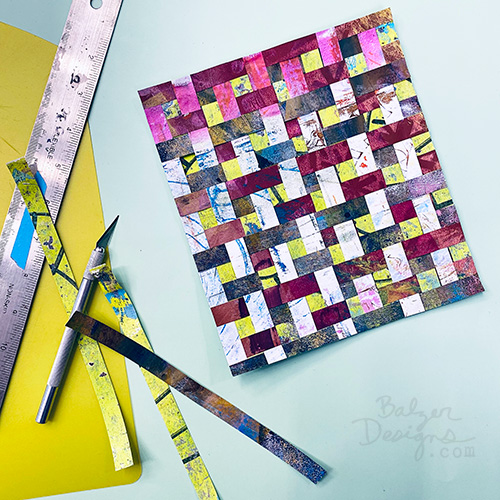
That shift — from unappealing parts to a cohesive whole — is what I want to talk about.
1. The Whole Matters More Than the Parts
Individually, my paper strips weren’t much to look at. But woven together, they became something visually rich and complex. It’s a good reminder: The artwork is what needs to be beautiful—not the starting materials. This applies far beyond weaving. In collage, art journaling, or even painting, we often get stuck waiting for the “perfect” materials. But sometimes the magic happens when imperfect pieces come together.
2. “Ugly” Materials Are Actually Liberating
There’s something freeing about working with materials you don’t feel precious about. When you’re not worried about ruining something “beautiful,” you:
- cut more boldly
- experiment more freely
- take risks you might otherwise avoid
Those so-called “ugly” papers become an invitation to play!
3. Process Takes Time (Even When It Looks Fast)
The finished video of this piece is just two minutes long, but in real time, it took close to an hour. (If you’d like to watch the real time version, monthly members can find it in the online classroom.)
Weaving, like many art processes, is slow and requires patience:
- figuring out patterns
- making mistakes
- undoing and starting over
That invisible labor is part of the work. The polished result hides the trial-and-error underneath.
4. Mistakes Are Built Into the Process
At one point, I realized my pattern wasn’t working and I had to pull everything out and start again. Blerg. It’s frustrating in the moment, but also completely normal. Making, unmaking, and remaking is not failure! Rather, it’s how the work evolves.
5. Simple Techniques Still Hold Depth
At its core, this weaving is the same over-under pattern many of us learned as kids. But even simple techniques can become complex and expressive when you:
- vary your materials
- play with pattern
- stay curious
There’s depth in revisiting the basics.
A Small Invitation
Even if paper weaving isn’t your thing, there’s still a lesson you can take away from this blog post: Next time you’re working in your art journal, making a collage, or experimenting with mixed media, reach for the papers you’ve been ignoring—the unfinished, the awkward, the “not good enough.” Cut them up. Combine them. See what happens!
You might discover that what seemed unremarkable on its own becomes something unexpectedly beautiful when given a new context.
Thanks for stopping by!

Hi Julie, thanks for the video. It reminds me that paper weaving is on my list of things to do. My thing is cloth weaving but I also love the look of woven paper. I do have a suggestion though: I cringe when I see you cutting all those strips with the ruler in the video. I have a ruler, purchased on Amazon, that has a guard to protect my fingers from the rotary cutter. Just search for “ruler with cutting guard.” So worth the investment! Thanks for your daily emails.
Very cool. Reminds me of quilting. Thanks for sharing!
I love this video! I have been curious about how to keep all those strips in order. The washi tape hack is pricelss! Thanks Julie.
Been wanting to try paper
weaving too!!
This looks so fun!