A gelatin print that doesn’t turn out as expected isn’t necessarily a failure. It’s information. I believe that one of the most useful skills an artist can develop is learning how to look at a disappointing result and ask, “What is this teaching me?” Bad prints can reveal that you used too much paint, chose the wrong consistency, pressed too lightly, or simply discovered that you prefer more contrast or white space.
In this Studio Snippet, I’m experimenting with found texture on a gelatin plate using a piece of corrugated plastic packaging. The first print isn’t quite what I want, but instead of giving up, I analyze the result, make a change, and try again. It’s a small demonstration of something that sits at the heart of art practice: paying attention, responding to what happens, and allowing each attempt to guide the next one.
Garbage Isn’t Really Garbage
My son says he wants to be a garbage man when he grows up. I think it’s mostly because of the cool robot arm that the garbage trucks around here use. But, sometimes I think it might be my influence. I do looooove garbage. It has so many uses for art! Watch the video for more:
Here are the papers I made in the video:
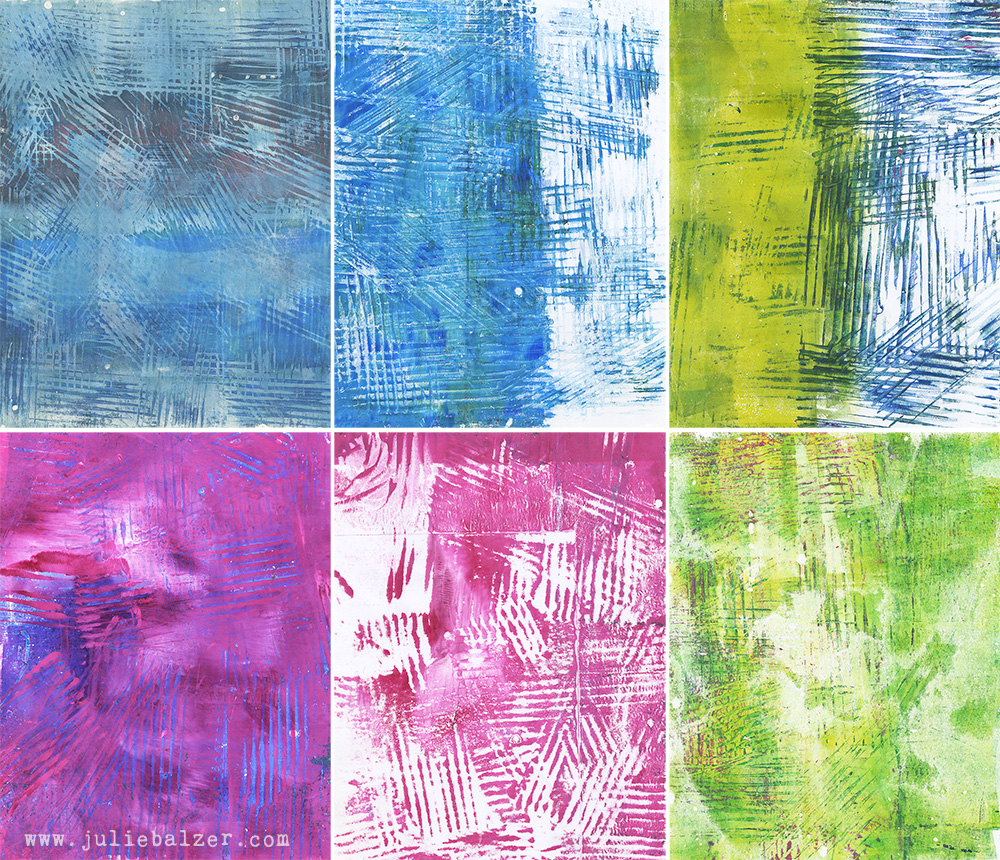
Lots of delicious texture!
Takeaways From the Video
Here are some things I hope you took note of during the video:
- Initially, I had too much paint on my gelatin plate, resulting in a less defined print.
- I, personally, like having more white space in the print, which indicated to me a need to remove more paint from the plate with the chocolate box. I experimented with fluid acrylics (because they’re thinner) to see if that got me the results I wanted.
- This is a reminder not to be discouraged by failures but to learn from things that don’t go as you intended. I always learn more from my mistakes than my successes. It’s all about trial and error.
- Analyzing my work helps me to understand what I like and what works, guiding my next steps. This is something I talk about a lot at My Art Practice.
- Gelatin printing is not random; it’s about understanding paint, color, opacity, and the materials you press into the plate to achieve controlled and desired results. I want to scream this from the rooftops. It’s not about being surprised. You can plan ahead!
P.S. If you want to learn more about gelatin printing, check out my online class, A Year of Gelatin Printing. It’s packed with over 200 videos, covering everything you need to know about gelatin printing, and as a bonus, it has 14 bookbinding projects!
Final Thought
The next time a print, or any piece of artwork, doesn’t turn out the way you hoped, resist the urge to label it a failure and move on. Instead, take a moment to figure out what the result is telling you. What do you like? What would you change? What could you try next? That kind of thoughtful adjustment is how you move from hoping for a happy accident to understanding how to create the results you want. Mistakes aren’t separate from the art-making process. They are an essential part of learning how your materials work and learning what you want your artwork to be!
Thanks for stopping by!


I love the tiny white blobs of gesso in the final print!
Thanks, Kathryn!