A scrapbook sketch can be a wonderful place to begin, especially when you want to make something but do not want to spend all your creative energy figuring out where everything should go. However, I do not think of a sketch as a set of instructions. I think of it as a structure I can push against.
This scrapbook layout began with Pencil Lines sketch #170:
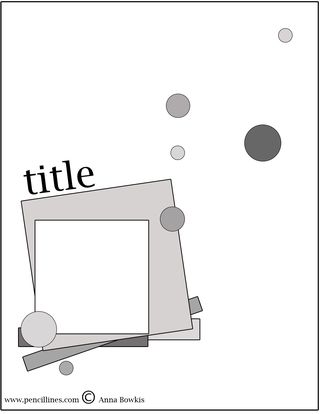
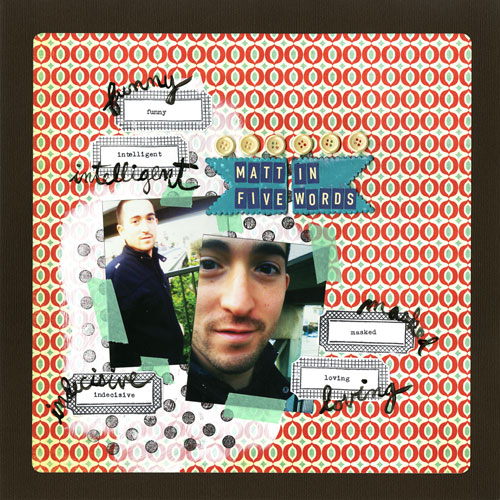
The original sketch gave me a strong underlying composition, but there was still plenty of room to change the materials, exaggerate certain elements, add layers, and make the finished piece feel like mine.
A Sketch Gives You Boundaries, Not Answers
To me, a good sketch creates a kind of safe container. Some of the design decisions have already been made, which means I can spend more time playing with color, pattern, texture, and scale. I do not need to copy every shape or place every element exactly where it appears in the sketch. Instead, I look at the relationships:
- Where is the visual weight?
- What creates movement?
- Where are the quiet spaces?
- How does the eye travel through the composition?
Once I understand those relationships, I can interpret them using my own visual language.
Creating Space in a Busy Pattern
The background paper I chose was intensely patterned, and my photographs were getting lost against it. Rather than covering the entire pattern, I used gesso to quiet one area of the paper, as you can see in this detail photo.
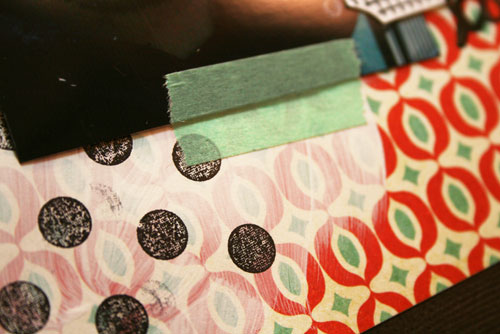
The translucent layer of gesso created a softer landing place for the photographs while allowing the original pattern to remain visible around them. I then stamped over the gesso and used washi tape to secure the photos.
You don’t need to copy exactly what I did. Rather, this is a useful solution whenever a background feels too busy. You do not need to remove or completely cover the pattern. Sometimes you simply need to interrupt it. A thin layer of paint, gesso, collage paper, or another translucent material can create enough contrast for the important elements to become visible.
Don’t Use Cheap Paint
I could not get the teal paint quite right on the first attempt or the second or the third. Sigh. It took four layers of paint before I was happy with the color.
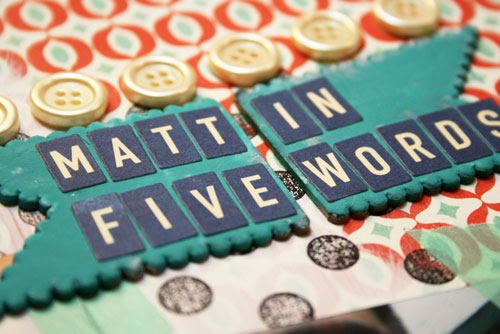
That’s what I get for using cheap craft paints. More expensive artist-grade paints are not always opaque, but they definitely have a higher pigment load. (Pigment is the expensive part of paint.)
The Last-Minute Decision That Changed the Layout
The painted words were a last-minute addition. The layout was nearly finished, and I could easily have stopped. But something still felt a little too polite. It needed more energy and intensity. Here is the layout before and after I painted the words:
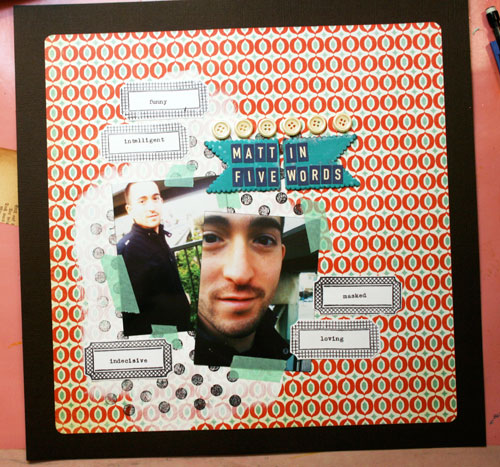
The difference is not enormous, but the words give the composition more personality. They add another layer of movement and help connect the bold graphic elements across the page.
This is one reason I like taking a photograph of artwork that feels almost finished. Seeing the piece on a screen, or even looking at it from across the room, can make it easier to notice what is missing.
You might ask:
- Does one area feel disconnected from the rest?
- Is there enough contrast?
- Does the composition need a repeated color, shape, line, or pattern?
- Is the work finished, or have I simply become afraid to change it?
Being Willing to Risk the Almost-Finished Piece
It can be difficult to put a paintbrush to something that is already working reasonably well. There is always the possibility that the new addition will make it worse. But being willing to make that final change is part of developing confidence as an artist. The goal is not to make reckless decisions. It is to remain responsive to the work instead of stopping simply because you are afraid to disturb it. The worst-case scenario is probably not that you have to start over. Most artistic decisions can be revised, covered, cut apart, painted over, or incorporated into the next layer. Learning how to respond when something does not work is far more valuable than protecting every piece from the possibility of failure. (Watch a video on this topic HERE.)
A sketch gave me the structure for this layout, but the gesso, layers of teal paint, stamping, washi tape, and painted words are what made it mine!

Do you find it easy to make changes when a piece is almost finished, or is that the moment when you become most cautious?
Thanks for stopping by!

i really, really, really like this!
Blessings,
I love it! My favorite part is the gesso on the patterned paper – genius. Also, I agree that the painted words make a huge difference. I admire that you will take risks – especially when your layout is basically finished! Great job.
Susan
I like the Lo without the painted words, but they do add quite a bit of zazz!