
Today, I want to share a slow stitching project with you. I made it for the Creative Therapy blog challenge.
The Creative Therapy blog was founded on the belief that art can be a powerful tool for self-exploration and healing. Created by a group of artists and storytellers, the blog shares weekly “catalysts”—thought-provoking prompts designed to inspire personal reflection through various creative mediums. The goal is to encourage self-expression, growth, and community through artistic practice, proving that the process of making is just as valuable as the finished piece.
This month’s prompt at the Creative Therapy blog is:
Describe (or show) yourself at this point in your life.
I made this small hand stitched quilt packed with yummy details.
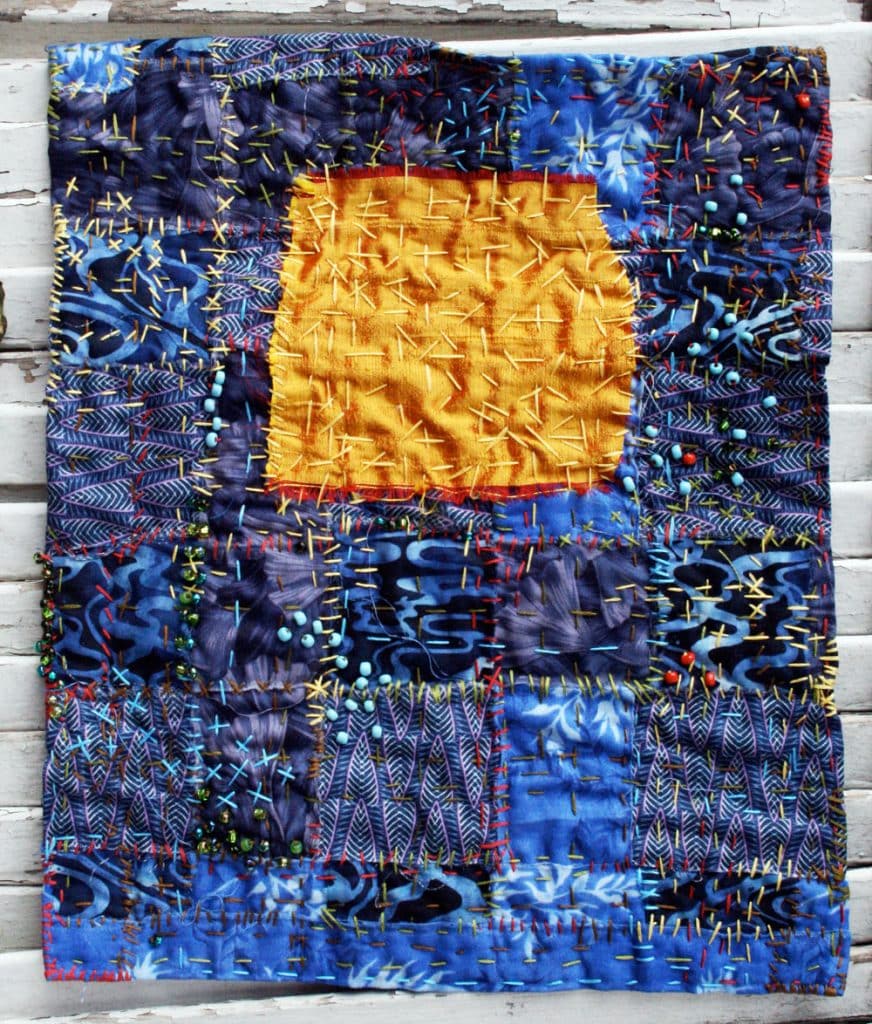
I’ve named the quilt, “Possibilities,” and every part of it has meaning:
- I wove strips of fabric together to represent paths taken.
- I added lots of hand stitching and beading to represent bumps and treasures along the journey.
- The large yellow square represents something new on the horizon — a door or a portal to a new adventure!
Here are some detail photos so that you can really see the texture of all of that slow stitching.


I’ve mentioned “slow stitching” a few times in this post, so I thought that I ought to explain a bit about what it is, in case you don’t know.
Slow Stitching as a Movement
Slow stitching is an artistic and meditative practice that embraces the process of hand-sewing as a form of mindful creativity. Inspired by the slow movement (which includes slow food, slow living, and slow fashion), slow stitching encourages makers to slow down, enjoy the tactile experience, and focus on personal expression rather than perfection.
Origins & Philosophy
- The slow stitching movement was popularized by Mark Lipinski, a quilter and designer who emphasized stitching as a form of creative meditation.
- Fun Fact: Mark came to my apartment to interview me in 2012. Read my blog post all about it.
- It rejects mass production and consumer-driven crafting in favor of thoughtful, process-focused creativity.
- The process draws inspiration from Japanese boro (a traditional mending technique using visible patchwork) and other historical hand-sewing traditions.

Key Principles of Slow Stitching
- Mindfulness & Intention – It’s about enjoying the process rather than rushing to finish a project.
- Sustainability – Many practitioners use upcycled fabrics, old garments, and repurposed materials.
- Imperfection is Welcome – Unlike traditional embroidery or quilting, slow stitching embraces raw edges, uneven stitches, and organic compositions.
- Personal Expression – It is highly individual, often including freeform designs, layered textures, and unique embellishments.
I wrote a post all about how much I’m enjoying slowing down with slow stitching and you can read it HERE.
Why I Think Slow Stitching is Gaining Popularity
- It provides a meditative and stress-relieving creative outlet (self care). And yet doesn’t require the tedious perfection of embroidery.
- Many artists and makers appreciate the connection to handmade traditions and sustainability.
- “The movement towards authenticity and personalization is also a rejection of consumer culture’s emphasis on disposability. By creating and cherishing handmade items, Gen Z is fostering a deeper appreciation for quality and longevity.” This quote is from an article that goes into great detail over the Gen Z craft revolution. (Yay!)
- It’s a great way to use fabric scraps! Lord knows I’m a fabric hoarder. It’s nice to find a place for all my little bits and bobs.
- PS: THIS is my favorite no-sew use for fabric scraps.
- The slow stitching movement is part of or related to visible mendin, and slow fashion — which are both huge right now.
What do you think? Does slow stitching interest you? Let me know in the comments. I’d love to hear from you!

I saw this over at Creative Therapy and I think it is just SO beautiful.. and change is certainly exciting.
I embrace change. It’s exciting. Good luck with your changes.
Love this piece as the stitches go off in different directions. And yellow and blue is my kind of colour combination!
Thanks for the inspirations.
Ulrike x
Good luck Julie!! I loved yesterday’s post too! xx
I love all your posts. I open up your blog when I get to my desk each day, because I love having that to think about as I progress through my day here at the law firm. I also like hearing about your changes, and I hope these are exciting ones. Good luck. My son is living in the Village this summer and if you are teaching any classes locally I may try to come into the city, stay with him, work at our New York office, and do something fun.
gorgeous AND inspiring! thank you much for sharing 🙂
thaks Julie, this little quilt is beautiful, love the symbolism of it and good luck with all your changes!
Funny that I checked that site last night and saw your project. Lovely and I hope that your changes bring you much joy Julie!
I get to my desk each morning too and check your blog! The hand stitching is such a colorful detail! I hope you enjoy all your new adventures!
fab-u-lous, julie!!! absolutely FABULOUS!!! xox
Love the abstract symbolism of the piece! Very nice!
Ooh! Now that’s a cliff hanger. Hope your changes bring you much happiness!
I love the tiny haphazard stitches and beads in the quilt. Adds so much texture and richness.